The Day Ravana Tried
to Control the Planets — A Dussehra Story
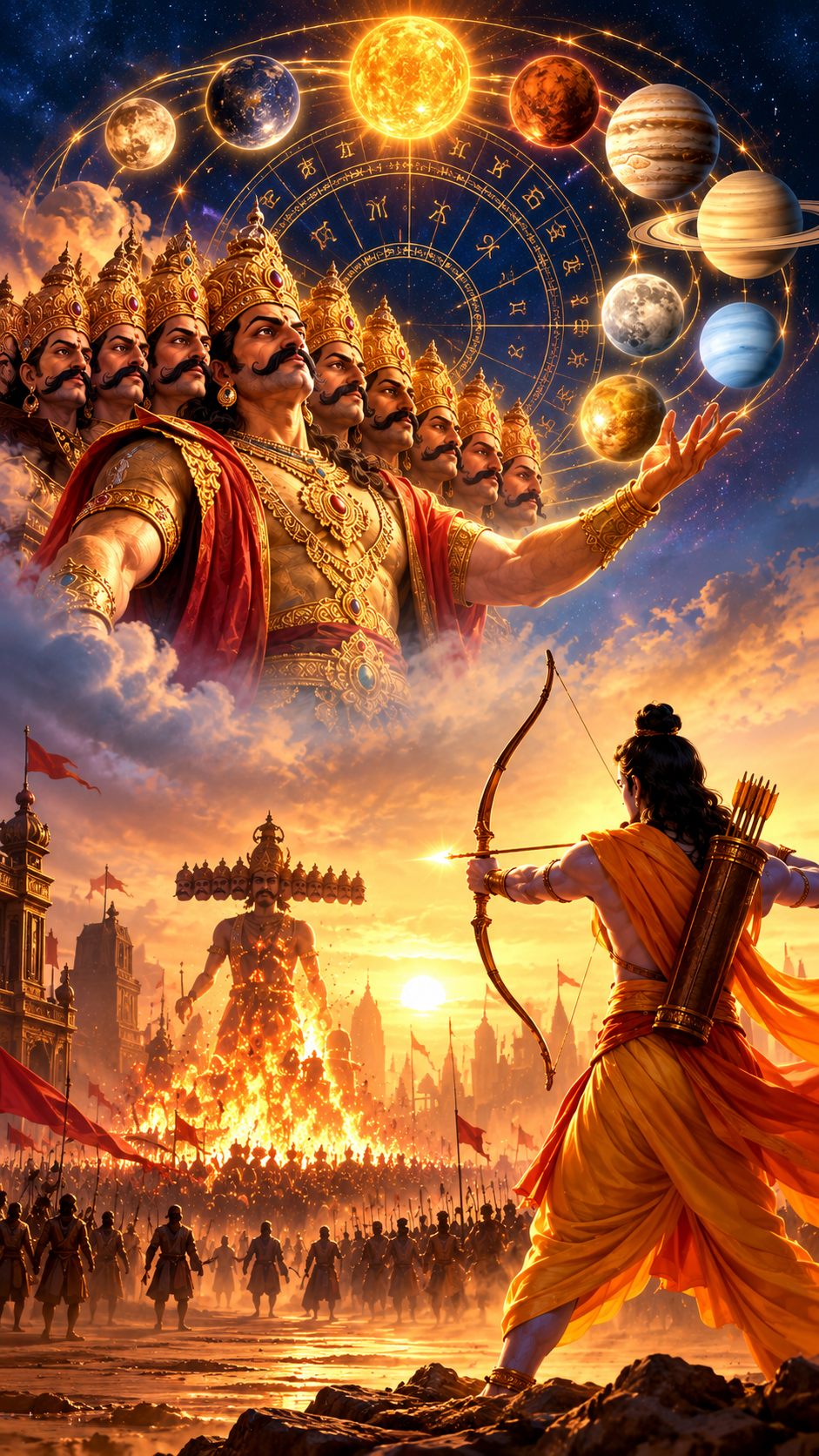
Every Dussehra, we watch Ravana burn. Ten heads, a towering effigy, and the crackle of fireworks as good triumphs over evil once again. But there is a lesser-told story about Ravana that I find myself returning to every year — and it has everything to do with the stars.
Because before he was the villain of the Ramayana, Ravana was one of the greatest scholars the world had known. A devotee of Shiva. A master of music, of Ayurveda, and of Jyotish — the very astrology I practise today. He knew the planets better than almost anyone.
And still, he could not command them.
The Story of Ravana and the Nine Planets
The story is told in many versions in folk tradition, but its heart is always the same. When Ravana’s wife Mandodari was expecting their son Meghnad, Ravana wanted to make sure this child would be invincible — unmatched in strength, intelligence and long life.
So he did what only Ravana would dare to do. Using his power, he ordered all nine planets to take the exact positions in his son’s birth chart that would guarantee this destiny. Every graha was to sit where it would bless the child, and nowhere else.
The planets, held under his command, obeyed. All except one.
At the moment of Meghnad’s birth, Shani — Saturn, the planet of karma and consequence — did not stay where he was told. He shifted, and in doing so placed a limit on the destiny Ravana had tried to write. Furious, Ravana struck him, and some versions say this is how Shani came to walk with a limp.
Meghnad grew into one of the mightiest warriors of his age. But in the end, he did not escape his karma. Neither did his father.
What This Story Teaches Us About Astrology
I think about this story whenever a client asks me to “fix” their chart — to make a difficult transit disappear, or promise that a hard phase will not touch them. I understand that wish so deeply. When life feels uncertain, we all want a little of Ravana’s power.
But astrology was never meant to bend the planets to our will. It is meant to help us see clearly — where the current is strong, where we need patience, where effort will bloom and where it is wiser to wait. Shani, especially, does not punish. He simply asks that our actions match our intentions. If you have been going through a heavy Saturn period, my post on Saturn Transit & Sade Sati explores this more gently.
Ravana had all the knowledge and none of the surrender. That is the real lesson of Dussehra for me: gyaan ke saath vinamrata zaroori hai — knowledge needs humility beside it.
The Ten Heads — Which One Is Yours?
A beautiful spiritual reading of Dussehra sees Ravana’s ten heads not as a monster’s features, but as ten patterns that live in all of us. We do not burn Ravana because he is someone else. We burn him because, in small ways, he is us.
Read through them slowly. One will probably feel uncomfortably familiar. That is not a reason for guilt — it is simply the head you are being invited to release this year.
Why Vijayadashami Is Perfect for New Beginnings
Dussehra 2026 falls on Tuesday, October 20, the day after Maha Navami. Traditionally, Vijayadashami is counted among the most auspicious days of the entire year — a day when new work can begin without searching for a separate muhurat. For generations, families have chosen it to start studies, open businesses, buy something meaningful, or make a commitment they have been putting off.
Nine nights of Navratri prepare the ground. Dussehra is the first step onto it. If you followed my Navratri numerology & tarot guide through the nine nights, this is the day to act on what came up for you.
A Simple Dussehra Ritual, Wherever You Are
Whether you are watching a Ravan Dahan in Delhi or celebrating quietly in Dubai, Toronto or London, this small practice brings the meaning of the day home:
- In the morning, offer a prayer to Maa Durga or Lord Rama, and light a diya. Many families also worship the Shami tree or exchange its leaves as a symbol of prosperity.
- Choose one head. From the ten above, pick the one pattern you are ready to let go of. Write it on a small piece of paper.
- In the evening, safely burn or tear the paper. Say quietly, in your own words, that you are releasing it.
- Begin one small new thing the same day — a habit, a plan, a conversation, a first step. Let the victory be practical, not just symbolic.
- Share sweets with someone. Victory is always meant to be shared.
If you live outside India, check a panchang set to your own city for the exact Vijay muhurat. But please do not worry about doing it perfectly. Ravana’s story is proof that control was never the point.
Frequently Asked Questions
Starting something new this Vijayadashami?
A new job, a relationship decision, a business, a move abroad — a personalised reading shows how your chart, your numbers and the cards support the step you are about to take. Sessions available worldwide in Hindi & English.
Book a Reading ❖ Chat on WhatsApp